
Considerations for Sustainability in Structures
How often do you consider the implications of specifying structural materials on projects? Is it a habit to evaluate the use of locally sourced materials on projects in a new region, or to include alternative cementitious materials in your mix designs? Are there ways to improve the resiliency of the communities in which we work and live?
In the May 2026 SEU Session, Dave Adams, SE, from BWE, Inc., presented Evaluating Sustainable Materials and Structures. Dave distinguished the difference between mandatory and optional compliance for sustainable development. He described sustainable elements of common building materials and examined the suitability of retrofit goals for existing structures. He illustrated the life cycle assessment issues related to building materials and discussed realistic goals that maximize stakeholder involvement.
NSPE describes sustainable development as the ‘challenge of meeting human needs for natural resources, industrial products, energy, food, transportation, shelter, and effective waste management while conserving and protecting environmental quality and the natural resource base essential for future development.” Unless required by an adopted code or standard, engineers are not typically required to implement specific sustainable objectives, however voluntary examination and consideration of sustainable objectives are expected and encouraged by our professional organizations, some state licensing board codes of ethics, as well as the general public. As structural engineers, it is our duty to “hold paramount” the health, safety and welfare of the public, and that duty extends to the case of future generations.
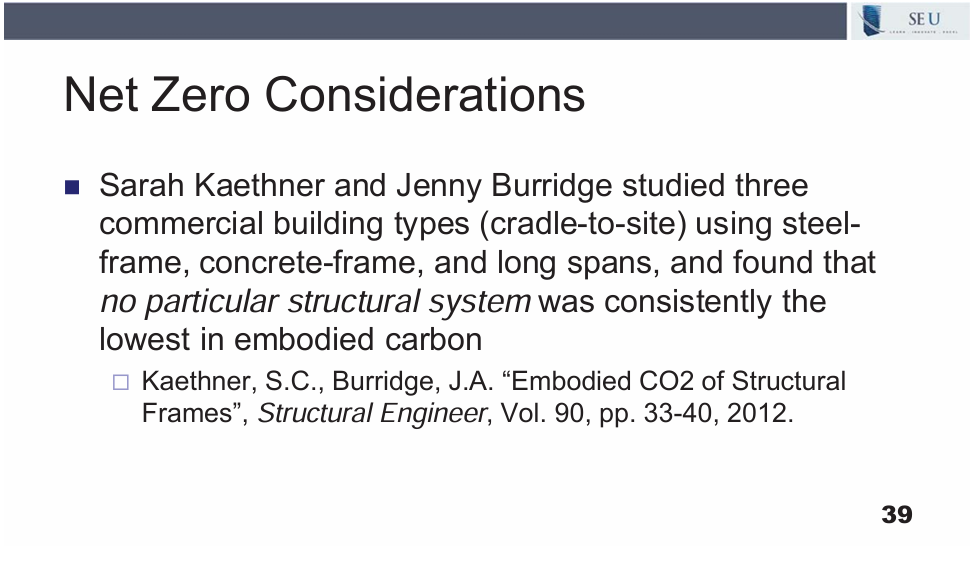
Dave explained the impossibility and complexity of comparing the sustainability of various structural materials directly to one another. However, it is the duty of structural engineers to be abreast of factors that affect sustainability in our selection of materials, as they work together to perform as a structural system. He cited a study which concluded that no particular structural system was consistently the lowest in embodied carbon, as shown on the slide below. However, once a structural system was selected, significant opportunities were apparent through careful specification and efficient design.
What then should structural engineers consider when selecting structural materials? Dave noted six considerations for engineers during design and specification on a project, as shown in the slide below:
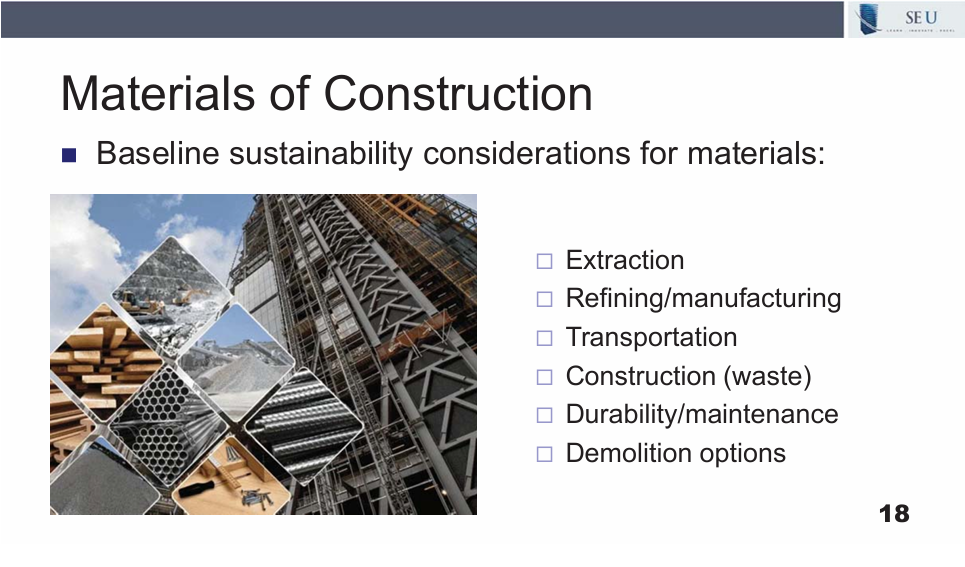
All six of these considerations can affect the sustainability and life cycle of a building material which contributes to the complexity of comparing materials as apples-to-apples. While timber may score high as a renewable resource, its durability may not compare to that of concrete. Emissions from the production of cement may lower the sustainability of using concrete as a structural material, however the thermal mass of the concrete structure may reduce future cooling loads for AC equipment compared to that of a steel structure. Steel structures are typically comprised of recycled content which is beneficial and newer methods are using renewable electricity sources in the production of steel to generate water as waste instead of carbon dioxide. Masonry also may be a consideration when local, indigenous products are available or unreinforced masonry can eliminate the need for cement-rich grout, thus reducing the carbon footprint. There are strategies available to reduce the environmental impact for each construction material and the ways in which they are extracted, manufactured, and transported. Engineers should continually educate themselves on emerging trends in sustainability and regional considerations for the betterment of the communities in which they work. The International Green Construction Code or IgCC is an excellent reference for a “whole systems” approach to increase economic and resource efficiency and reduce effects of climate change through more resilient buildings. Some state or local jurisdictions may wholly or individually adopt guidelines from the IgCC, and engineers may need to familiarize themselves with these regulations which may be mandatory or optional depending on their jurisdiction.
Sustainability continues to be an ever-evolving topic within the structural engineering profession and engineers can move toward a more active approach in promoting sustainable options to their clients and community.

There are no comments yet, but you can be the first