
24 Sep / 2026
SJI 100 and 500 Pound Rule
Steel roof and floor joists are often used due to their flexibility in supporting ductwork, mechanical equipment, or architectural finishes. However, loads added in the field can require costly modifications to joists, if they are unplanned or placed without proper consideration. How can these costly additions be avoided when using steel joists?
In the August 2026 SEU session, Bruce Brotherson, PE, SE, an Innovation Architect from Vulcraft, and Walter Worthley, PE, SE, from SEQ Engineering, LLC, presented Evaluation, Modification, Retrofit: Steel Joists, Roof, and Floors. Bruce demonstrated examples of joists that can be retrofitted and should not be retrofitted. He also identified key characteristics of in-place joists and explained how to determine who the original manufacturer was and whether they can provide additional documentation. Bruce described how to verify the original design loads and evaluate the joists for new loads. Walt then covered methods and practices to modify existing joists to increase the load carrying capacity and shared some commonly used details to increase the load capacity of a joist component.
Bruce explained guidance offered by SJI based on testing of concentrated loads on steel joists. As shown on the slide below and noted in the 45th Edition of the SJI Specification, the 100 pound rule says concentrated loads up to 100 pounds may be applied within any top or bottom chord panel, so long as the load was included in the uniform design load, and is applied concentrically to the chord. This eliminates the need for an additional angle strut to be added and reduces labor costs when these minimal loads are added along the length of the joist.
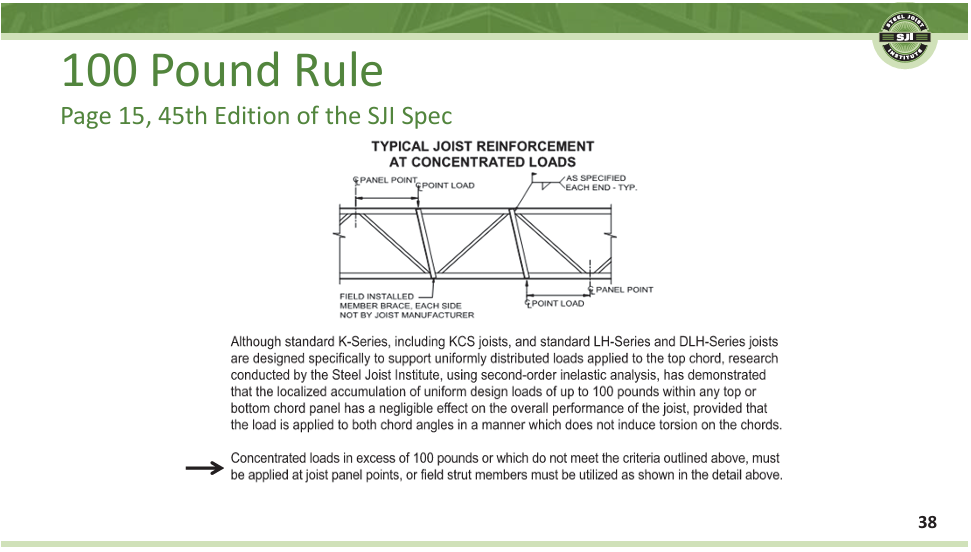
Bruce also shared new research completed by SJI which is known as the 500 pound rule. This rule allows for the addition of a single 500 pound load applied within 6 inches of any panel point without the need for a field installed strut as long as the load was accounted for in the uniform design load and it is applied concentrically to the joist chord However, the 500 pound rule and 100 pound rule cannot be combined within the same panel zone. To watch a short video from SJI explaining these two useful rules, click here.
Adding struts in the field for various hanging loads from joists is a common practice, however, this new guidance from SJI can help to minimize the need for these costly, labor-intensive additions.
24 Sep / 2026
“SEU Speaker Inspires” Organization of the Month: Structural Engineers Association of Southern California Foundation

Matthew Mester, PE, SE MiTek, Inc.
In March 2026, Matthew Mester, PE, SE, from MiTek, Inc., presented Changes to Steel: AISC 360 & 341 Code Updates. In 2017 and 2023, he nominated the Structural Engineers Association of Southern California Foundation (http://www.seaosc.org) for the SEU Speaker Inspires donation of the month, and he has chosen to do the same in 2026.
The Structural Engineers Association of Southern California Foundation, in its goals to further the development of the structural engineering profession, looks for partners, be it individuals, companies or corporations, to pursue structural engineering innovation and research for use in the public domain. The foundation can assist in the development process of specific structural engineering research projects and publishing of any findings.
The foundation is dependent upon donations for its operation and funding of research projects and annual student scholarships. Matthew chose to donate to the SEAOSC Foundation for student scholarships to “help the next generation of structural engineers.”
Thank you, Matthew, for helping structural engineers with your SE University session, and for your designation of the Structural Engineers Association of Southern California Foundation as our SEU Speaker Inspires Organization of the Month!
SE University began the SEU Speaker Inspires program in 2015 as a way to “pay it forward”, enabling our speakers to designate a charity/organization of their choice for SE University to make a donation to help improve our world.
27 Aug / 2026
Useful Tips for PT Specifications
What is the best way to avoid common mishaps and communication lapses on post-tensioned building projects? While every building project needs good communication between all involved parties, there are best practices which can improve the trajectory of a project, especially in PT design and construction.
In the December 2025 SEU session, Carine Leys, from WSP, presented The Design Arc of Post-Tensioning. Carine explained how to evaluate during the conceptual phase if post-tensioning is a structural solution that meets the project’s performance requirements. She reviewed ways to develop comprehensive documentation relevant to each phase of the project and identified best practices during construction to ensure safety and durability.
Carine offered many useful tips for providing comprehensive requirements on the project’s PT specifications. These PT specs should include specifications for installation, stressing procedures, approval of stressing records, as well as requirements for installer and inspector qualifications. To hear Carine explain some best practices for PT specs, click on this 5 minute video:
Carine noted the importance of including the PT specifications, at a minimum, by the 50% Construction Document phase to ensure maximum time to coordinate with all disciplines. Including specs early on in the design process allows for collaboration and time to address any issues that may arise.
As Carine noted, the PT industry has changed in the last decade, and less experienced installers are more abundant. PT specifications can help to ensure your projects hire qualified installers and inspectors which will eliminate potential mishaps due to inexperienced contractors. PT specs can delineate which shop drawing submittals are required for approval to ensure what is provided on-site matches the intended PT design and layout. Specs should also include requirements for the installation of tendons and standards to follow and include tolerance for any deviations which may occur. The more clearly these standards are delineated in the PT specifications, the less conflicts should arise during your PT projects.
Scott Russell, SE, PE, Nucor
In February 2026, SEU welcomed Scott Russell, PE, from Nucor, to present ASCE 7-22 Snow & Rain Loading with Suggestions on Joist Specification. Scott designated Engineers without Borders (Engineers Without Borders) for our SEU Speaker Inspires donation for the month.
Engineers without Borders USA builds a better world through engineering projects that empower communities to meet their basic human needs. According to their website, their highly skilled volunteers work with communities to find appropriate solutions for their infrastructure needs.
Thank you, Scott, for helping structural engineers with your SEU session, and for your designation of Engineers without Borders as our SEU Speaker Inspires Organization of the Month!
SEU began the SEU Speaker Inspires program in 2015 as a way to “pay it forward”, enabling our speakers to designate a charity/organization of their choice for SEU to make a donation to help improve our world.
27 Aug / 2026
Considerations for Sustainability in Structures
How often do you consider the implications of specifying structural materials on projects? Is it a habit to evaluate the use of locally sourced materials on projects in a new region, or to include alternative cementitious materials in your mix designs? Are there ways to improve the resiliency of the communities in which we work and live?
In the May 2026 SEU Session, Dave Adams, SE, from BWE, Inc., presented Evaluating Sustainable Materials and Structures. Dave distinguished the difference between mandatory and optional compliance for sustainable development. He described sustainable elements of common building materials and examined the suitability of retrofit goals for existing structures. He illustrated the life cycle assessment issues related to building materials and discussed realistic goals that maximize stakeholder involvement.
NSPE describes sustainable development as the ‘challenge of meeting human needs for natural resources, industrial products, energy, food, transportation, shelter, and effective waste management while conserving and protecting environmental quality and the natural resource base essential for future development.” Unless required by an adopted code or standard, engineers are not typically required to implement specific sustainable objectives, however voluntary examination and consideration of sustainable objectives are expected and encouraged by our professional organizations, some state licensing board codes of ethics, as well as the general public. As structural engineers, it is our duty to “hold paramount” the health, safety and welfare of the public, and that duty extends to the case of future generations.
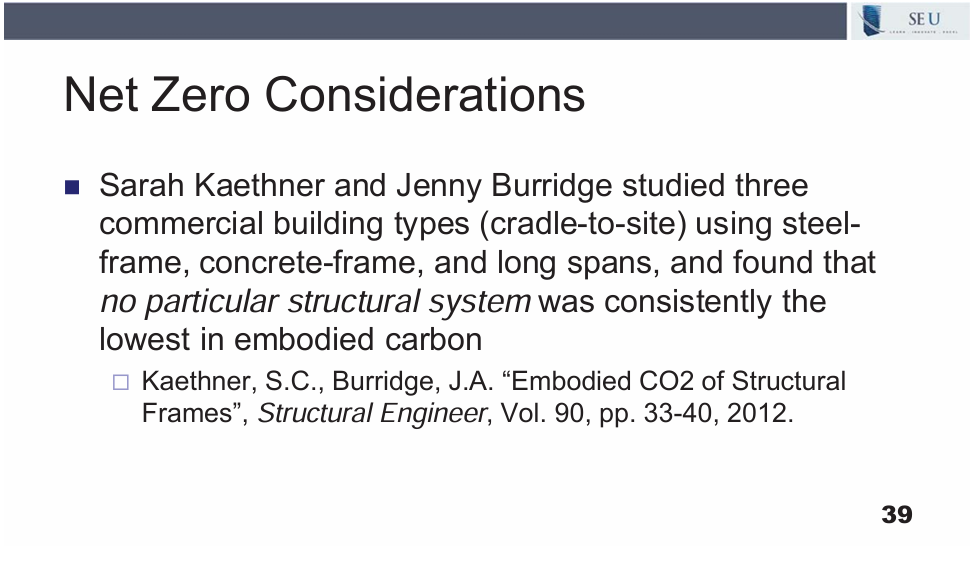
Dave explained the impossibility and complexity of comparing the sustainability of various structural materials directly to one another. However, it is the duty of structural engineers to be abreast of factors that affect sustainability in our selection of materials, as they work together to perform as a structural system. He cited a study which concluded that no particular structural system was consistently the lowest in embodied carbon, as shown on the slide below. However, once a structural system was selected, significant opportunities were apparent through careful specification and efficient design.
What then should structural engineers consider when selecting structural materials? Dave noted six considerations for engineers during design and specification on a project, as shown in the slide below:
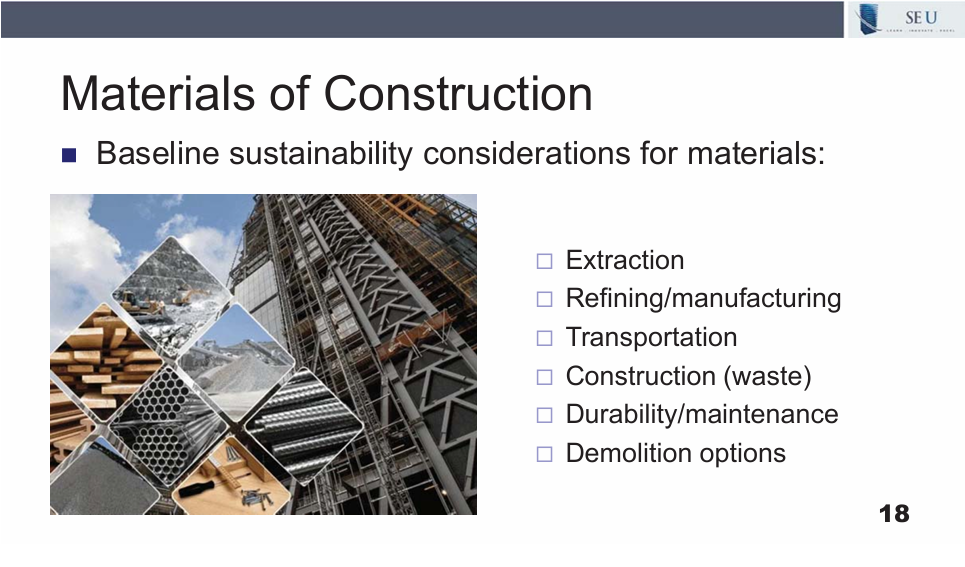
All six of these considerations can affect the sustainability and life cycle of a building material which contributes to the complexity of comparing materials as apples-to-apples. While timber may score high as a renewable resource, its durability may not compare to that of concrete. Emissions from the production of cement may lower the sustainability of using concrete as a structural material, however the thermal mass of the concrete structure may reduce future cooling loads for AC equipment compared to that of a steel structure. Steel structures are typically comprised of recycled content which is beneficial and newer methods are using renewable electricity sources in the production of steel to generate water as waste instead of carbon dioxide. Masonry also may be a consideration when local, indigenous products are available or unreinforced masonry can eliminate the need for cement-rich grout, thus reducing the carbon footprint. There are strategies available to reduce the environmental impact for each construction material and the ways in which they are extracted, manufactured, and transported. Engineers should continually educate themselves on emerging trends in sustainability and regional considerations for the betterment of the communities in which they work. The International Green Construction Code or IgCC is an excellent reference for a “whole systems” approach to increase economic and resource efficiency and reduce effects of climate change through more resilient buildings. Some state or local jurisdictions may wholly or individually adopt guidelines from the IgCC, and engineers may need to familiarize themselves with these regulations which may be mandatory or optional depending on their jurisdiction.
Sustainability continues to be an ever-evolving topic within the structural engineering profession and engineers can move toward a more active approach in promoting sustainable options to their clients and community.
Thomas Heausler, PE, SE, Heaulser Structural Engineers
In January 2026, SEU welcomed back Thomas Heausler, PE, SE, from Heausler Structural Engineers, to present Seismic Design for Low Seismic Risk Locations – Seismic Design Categories A, B, and C. Thomas designated Tau Beta Pi (Tau Beta Pi – The Engineering Honor Society) for our SEU Speaker Inspires donation for the month.
Thomas shared “I chose to donate to Tau Beta Pi because I saw achieving membership in it as being a lofty goal when I started Tulane University Engineering School. Tau Beta Pi was founded in 1885 and their motto is “Integrity and Excellence in Engineering”. I wish to support Tau Beta Pi’s continued success in their mission, which is, to recognize academic and professional excellence, promote a well-rounded education, provide opportunities for leadership development, and cultivate a community of high achievers.”
Thank you, Thomas, for helping structural engineers with your SEU session, and for your designation of Tau Beta Pi as our SEU Speaker Inspires Organization of the Month!
SEU began the SEU Speaker Inspires program in 2015 as a way to “pay it forward”, enabling our speakers to designate a charity/organization of their choice for SEU to make a donation to help improve our world.
27 Jul / 2026
Updates to ASCE/SEI 7-22 Rain Loading
New equations are in store for those engineers using ASCE 7-22 to determine design rain loads. Are you familiar with all of the changes included in Chapter 8?
In the February 2026 SEU Session, Scott Russell, SE, PE, from Vulcraft, presented ASCE/SEI 7-22 Snow & Rain Loading with Suggestions on Joist Specification. Scott described significant updates to the snow provisions in ASCE 7-22 and identified new provisions for thermal factors, snow drift heights and windward drifts widths and how to apply them. He also explained the revised rain load calculation methodology in Chapter 8 and reviewed how to specify joists and joist girders for these new changes to ASCE 7-22.
Scott addressed the major update to the modified design rain load calculation which now includes ponding head and uses an updated return period based on risk category. The most significant change appears in Equation 8.2.1, which includes dp which is a ponding head equal to the depth of water due to deflection of the roof subjected to unfactored rain load and unfactored dead load. As you can see in the slide below, dp develops after the Primary drain is clogged, the hydraulic head has formed to achieve drainage through the Secondary Drainage System, and the roof deflects under the additional ponding rain load, creating the Ponding Head, dp.
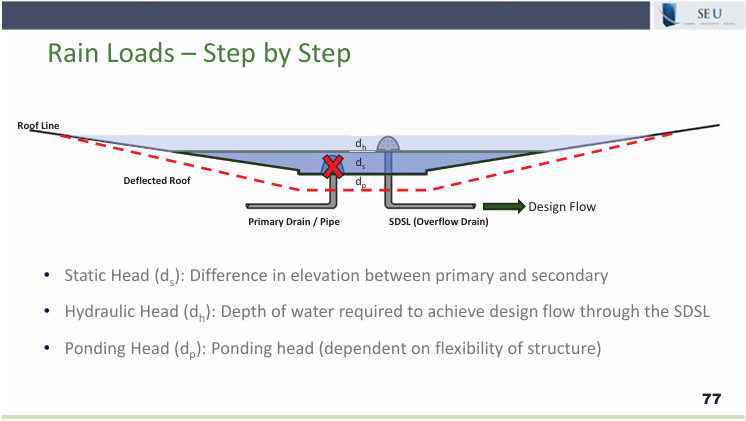
In the past, the Return Period for rain events was 100 years in all cases. ASCE 7-22 has included changes to the Return Period based on Risk Category. Risk Category III now uses a 200 year Return Period and Category IV uses a 500 year Return Period, as shown in Table 8.2-1. The hydraulic head, dh, can then be calculated using Tables C8.2-1 and C8.2-3 depending on the type of secondary drain used.
The Ponding Head, dp, can then be calculated through an interactive approach. Scott recommends using the free and newly updated SJI Ponding Analysis Tool which can be accessed by clicking on the link. Scott also referenced the research performed by Mark Denavit in 2019 which appeared in Engineering Structures and can guide the user through the amplified first-order analysis.
Scott noted other small changes to Section 8.3 Bay with Low Slope which directs the user where to expect ponding, and Section 8.4 which warns against drainage systems for new construction discharging water onto existing roofs unless the existing roof is re-evaluated and/or modified to support the new loads,
The new changes to the rain loads in ASCE 7-22 provide the method to determine the new Design Rain Load and offer guidance on roofs that may be susceptible to ponding. Be sure to check out the most recent version of the SJI Ponding Analysis Tool to assist your future roof designs and reduce calculation time for this new iterative analysis.
29 Jun / 2026
TnA Bolts a New Option in AISC 360-22
A new option for a high strength fastener has been included in AISC 360 and engineers may be interested in the benefits of using this new system. With the possibility of saving on material and labor costs, the new TnA bolt could be a solution on your next project.
In the March 2026 SEU session, Matt Mester, PE, SE from MiTek, Inc. presented Changes to Steel: ASIC 360 and 341 Code Updates. Matt reviewed when the building code requires the use of AISC 360/341-16 versus AISC 360/341-22. He noted significant changes in AISC 360 and 341 and described some of the new structural systems and materials/grades that are allowed in the new AISC 360 and 341.
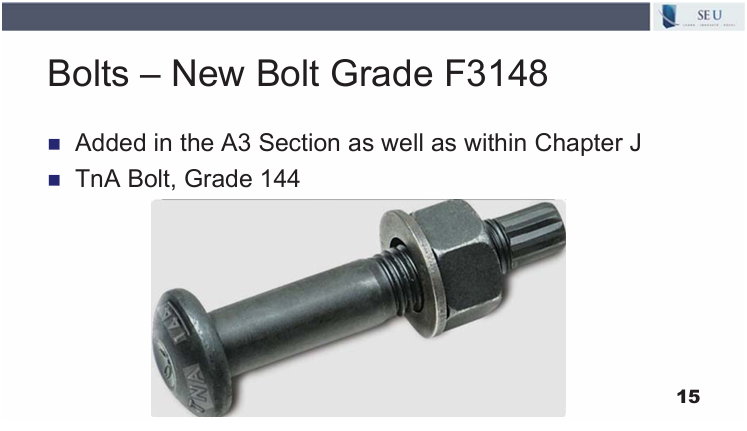
Matt noted the addition of a new bolt in AISC 360 which meets the ASTM F3148 specification. The torque and angle bolt, or TnA bolt, grade 144 has been added in the A3 section as well as within Chapter J. The TnA bolt installation process ensures each bolt is installed to an accurate snug tight condition and then is turned to the required angle to reach a precise final tension. The new bolt offers more reliability than a typical snug tight installation. The TnA bolt grade is 144 which falls between the popular A325 bolt which is grade 120 and A490 bolts which are grade 150. The higher strength could require the use of less bolts compared to the standard A325, which could reduce costs.
As you can see in the slide below, this new bolt has a stub on the end which is similar to a Tension Controlled bolt. However, while the TC bolt stub falls off once the bolt reaches the required pretension force, the stub on the TnA bolt remains in place even after the bolt is torqued to a snug tight condition. This could be a potential downside on jobs where the design tolerances are quite minimal, and the remaining stub could cause a conflict. However, it also allows for removal of the bolt using the same wrench which could be an advantage, especially in structures that may be temporary in nature. The addition of the TnA bolt to the specification gives engineers a new option for a fastener with a mid-grade strength.
29 Jun / 2026
Ethical Advice and Decision Making
Being ethical can be hard. Professional engineers are tasked with sound engineering judgement as well as protecting the safety and welfare of the public. Structural engineers often face ethical dilemmas that can be murky waters to navigate. From whom can engineers seek wise counsel regarding ethical dilemmas?
In the February 2026 SEU Ethics session, Barry Arnold, PE, SE, retired from ARW Engineers, presented 8 Tips to Avoid the Traps of Unethical Behavior. Barry explained the fundamental purpose and principles of the Code of Ethics. He described 8 tips to build a solid ethical foundation and improve one’s ethical IQ, and identified resources to aid in ethical decision making.
Barry gave an important tip for engineers who are faced with an ethical dilemma. After confronting and understanding the problem, engineers need to be aware of their own and other’s biases. To hear Barry explore the importance of this tip, watch this short video:
Seeking advice on ethical dilemmas requires introspection and careful examination of the biases of yourself and others. In most cases, it would be valid to seek out multiple opinions from trusted sources and unbiased third parties to try to eliminate any conflicts of interest in ethical decision making. Each instance requires a unique perspective because ethical dilemmas are so varied and nuanced and engineers typically are not well seasoned on dealing with ethical issues, especially newly licensed engineers. Barry rightfully recommends examining the biases and motivations of those in whom one seeks advice when faced with ethical dealings to avoid self interests or covert coverups.
26 May / 2026
“SEU Speaker Inspires” Organization of the Month: National Military Family Association
Sam Rubenzer, SE, PE, FORSE Consulting
In November 2025, SEU welcomed back Sam Rubenzer, SE, PE, from FORSE Consulting, to present Welcome to the New Age of Delegating the Design of Masonry. Sam has designated the National Military Family Association (Serving Military Families Since 1969) for our SEU Speaker Inspires donation for the month.
Sam designated the National Military Family Association in honor of the recent Veteran’s Day holiday, as well as a tribute to his family members who are veterans and active military members. NMFA meets the immediate needs of America’s military families with programs designed to support their financial security, well-being, and quality of life, as well as advocating for support from our government officials to serve the unique needs and challenges of service members of all branches of our US military.
Thank you, Sam, for helping structural engineers with your SEU session, and for your designation of the National Military Family Association as our SEU Speaker Inspires Organization of the Month!
SEU began the SEU Speaker Inspires program in 2015 as a way to “pay it forward”, enabling our speakers to designate a charity/organization of their choice for SEU to make a donation to help improve our world.