26 Oct 2026
SJI Joist and Joist Girder Reinforcement Tool
Structural engineers are often tasked with making modifications to existing floor or roof structures to accommodate new equipment or changes in use loads that were not considered in the original structural design. Many options exist to alter steel joists and joist girders to increase their load carrying capacity, however the alterations can be complex. Are you aware that the Steel Joist Institute offers a useful tool to aid in the design of reinforcing existing steel joists and joist girders?
In the August 2026 SEU session, Bruce Brotherson, PE, SE, an Innovation Architect from Vulcraft, and Walter Worthley, PE, SE, from SEQ Engineering, LLC, presented Evaluation, Modification, Retrofit: Steel Joists, Roof, and Floors. Bruce demonstrated examples of joists that can be retrofitted and those that should not be retrofitted. He also identified key characteristics of in-place joists and explained how to determine who the original manufacturer was and whether they can provide additional documentation. Bruce described how to verify the original design loads and evaluate the joists for new loads. Walt then covered methods and practices to modify existing joists to increase the load carrying capacity and shared some commonly used details to increase the load capacity of a joist component.
Walt highlighted a useful tool offered by SJI as a free download on their website. The Joist and Joist Girder Reinforcement Tool was developed by SJI to assist the engineer and steel fabricator with the complex task of reinforcing open web steel joists and joist girders to accommodate additional loads for which they were not originally designed. As you can see in the slide below, one of the 17 available spreadsheets in this tool helps to calculate the distribution of an added load between 3 or 4 adjacent joists. The additional spreadsheets offer options for reinforcing the top chord, bottom chord, and webs with various combinations of rods, angles, and plates. The design tool is based on the guidance provided in SJI Technical Digest 12 – Modification of Open-Web Steel Joists and Joist Girders, the SJI 45th Edition Catalog, and the AISC 360-16 Specifications. Be sure to check out this useful tool on your next retrofit project to assist in the reinforcement of existing joists and joist girders.
26 Oct 2026
“SEU Speaker Inspires” Organization of the Month: SEAONC Diversity in Structural Engineering Scholarship

Kevin S. Moore, PE, SE, Martin/Martin Consulting Engineers
In April 2026, SEU welcomed back Kevin S. Moore, PE, SE, from Martin/Martin Consulting Engineers, to present Using the 2024 International Existing Building Code for Buildings in Seismically Active Regions Kevin has previously designated SEAONC Diversity in Structural Engineering Scholarship (SEAONC Diversity, Equity, Inclusion (DEI) Restricted Fund Endowment – Structural Engineers Association of Northern California) for our SEU Speaker Inspires donation for the month when he presented in 2023 and 2024, and he has chosen to do the same in 2026.
Kevin shared, “The opportunity to increase funding in a permanent endowed scholarship that financially supports a student from an historically underrepresented minority in structural engineering, preferably with a desire to practice in northern California, is a very small but rewarding privilege. Thousands of capable students desire a rewarding career in our noble profession, but often face unfair challenges and financial shortfalls that fail to cover costs associated with very expensive university programs. Scholarships like this help bring some amount of equity to students that have done so much themselves. I am proud to be a part of a community that cares enough to contribute and even happier that SEU sees the value in doing the same.”
Thank you, Kevin, for helping structural engineers with your SEU session, and for your designation of SEAONC Diversity in Structural Engineering Scholarship as our SEU Speaker Inspires Organization of the Month!
SEU began the SEU Speaker Inspires program in 2015 as a way to “pay it forward”, enabling our speakers to designate a charity/organization of their choice for SEU to make a donation to help improve our world.
26 Oct 2026
Anchor Rods and Shear Lugs
Shear lugs can be necessary when large shear forces are being transferred at a baseplate attachment, however, the interaction between the shear lug, base plate, and anchor rods can be muddled depending on the way the connection is detailed. Should the anchors carry a portion of the shear force or not?
In the July 2026 SEU Session, Barry Arnold, PE, SE, retired from ARW Engineers, presented Shear Lugs: Myths, Mysteries, and Misunderstandings when Dealing with Concrete Connections. Barry outlined the structural engineer’s responsibilities when designing shear lugs from both the structural steel and concrete standpoint. He noted what information is not contained in the applicable code but should be considered in the design of shear lugs, and pointed out some common pitfalls with shear lugs which can lead to unsatisfactory results.
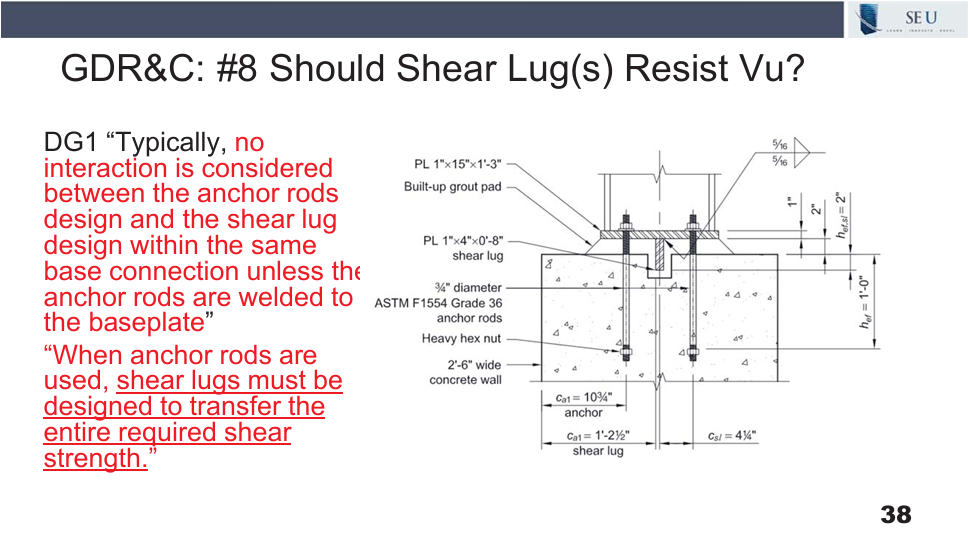
Barry shared some General Design Requirements and Considerations for the use of shear lugs and specifically noted some useful guidance from AISC Design Guide 1 (Third Edition): Base Connection Design for Steel Structures. As noted in Design Guide 1, shear lugs are typically designed to transfer the entire required shear strength, and no interaction is considered between the anchor rods and the shear lug. However, if the anchor rods are welded to the base plate, then shear interaction should be considered. Thus checks for steel strength in shear, concrete breakout strength in shear, and concrete pryout strength in shear should be evaluated. Barry noted that ACI 17.11.1.1.3 requires that anchors welded to the attachment base plate be considered for the tension and shear interaction requirements of 17.8, and shall include a portion of the total shear on the anchor. This guidance from ACI and AISC Design Guide 1 clarifies when anchors should be included in the shear design along with the shear lug, and when they remain a tensile only component of the base plate design.
24 Sep 2026
SJI 100 and 500 Pound Rule
Steel roof and floor joists are often used due to their flexibility in supporting ductwork, mechanical equipment, or architectural finishes. However, loads added in the field can require costly modifications to joists, if they are unplanned or placed without proper consideration. How can these costly additions be avoided when using steel joists?
In the August 2026 SEU session, Bruce Brotherson, PE, SE, an Innovation Architect from Vulcraft, and Walter Worthley, PE, SE, from SEQ Engineering, LLC, presented Evaluation, Modification, Retrofit: Steel Joists, Roof, and Floors. Bruce demonstrated examples of joists that can be retrofitted and should not be retrofitted. He also identified key characteristics of in-place joists and explained how to determine who the original manufacturer was and whether they can provide additional documentation. Bruce described how to verify the original design loads and evaluate the joists for new loads. Walt then covered methods and practices to modify existing joists to increase the load carrying capacity and shared some commonly used details to increase the load capacity of a joist component.
Bruce explained guidance offered by SJI based on testing of concentrated loads on steel joists. As shown on the slide below and noted in the 45th Edition of the SJI Specification, the 100 pound rule says concentrated loads up to 100 pounds may be applied within any top or bottom chord panel, so long as the load was included in the uniform design load, and is applied concentrically to the chord. This eliminates the need for an additional angle strut to be added and reduces labor costs when these minimal loads are added along the length of the joist.
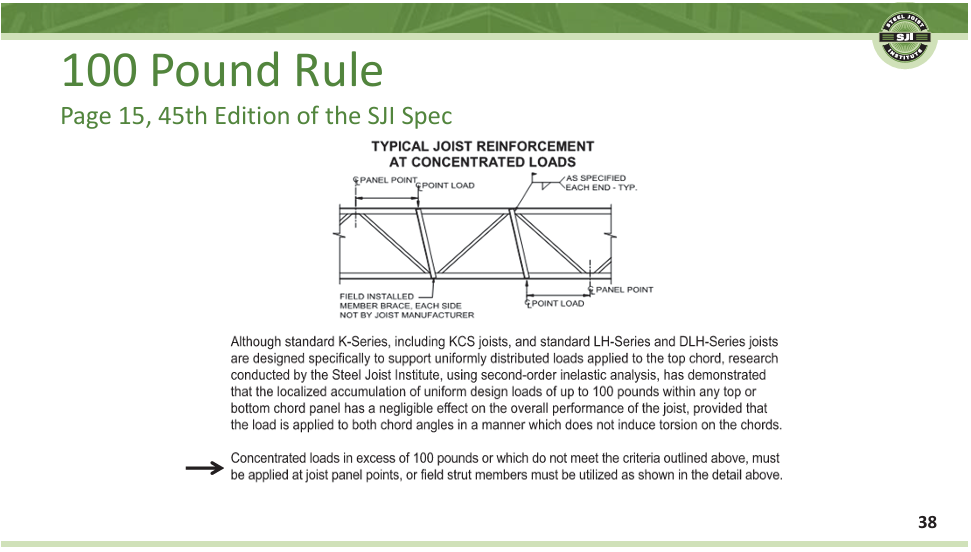
Bruce also shared new research completed by SJI which is known as the 500 pound rule. This rule allows for the addition of a single 500 pound load applied within 6 inches of any panel point without the need for a field installed strut as long as the load was accounted for in the uniform design load and it is applied concentrically to the joist chord However, the 500 pound rule and 100 pound rule cannot be combined within the same panel zone. To watch a short video from SJI explaining these two useful rules, click here.
Adding struts in the field for various hanging loads from joists is a common practice, however, this new guidance from SJI can help to minimize the need for these costly, labor-intensive additions.

Matthew Mester, PE, SE MiTek, Inc.
In March 2026, Matthew Mester, PE, SE, from MiTek, Inc., presented Changes to Steel: AISC 360 & 341 Code Updates. In 2017 and 2023, he nominated the Structural Engineers Association of Southern California Foundation (http://www.seaosc.org) for the SEU Speaker Inspires donation of the month, and he has chosen to do the same in 2026.
The Structural Engineers Association of Southern California Foundation, in its goals to further the development of the structural engineering profession, looks for partners, be it individuals, companies or corporations, to pursue structural engineering innovation and research for use in the public domain. The foundation can assist in the development process of specific structural engineering research projects and publishing of any findings.
The foundation is dependent upon donations for its operation and funding of research projects and annual student scholarships. Matthew chose to donate to the SEAOSC Foundation for student scholarships to “help the next generation of structural engineers.”
Thank you, Matthew, for helping structural engineers with your SE University session, and for your designation of the Structural Engineers Association of Southern California Foundation as our SEU Speaker Inspires Organization of the Month!
SE University began the SEU Speaker Inspires program in 2015 as a way to “pay it forward”, enabling our speakers to designate a charity/organization of their choice for SE University to make a donation to help improve our world.
27 Aug 2026
Useful Tips for PT Specifications
What is the best way to avoid common mishaps and communication lapses on post-tensioned building projects? While every building project needs good communication between all involved parties, there are best practices which can improve the trajectory of a project, especially in PT design and construction.
In the December 2025 SEU session, Carine Leys, from WSP, presented The Design Arc of Post-Tensioning. Carine explained how to evaluate during the conceptual phase if post-tensioning is a structural solution that meets the project’s performance requirements. She reviewed ways to develop comprehensive documentation relevant to each phase of the project and identified best practices during construction to ensure safety and durability.
Carine offered many useful tips for providing comprehensive requirements on the project’s PT specifications. These PT specs should include specifications for installation, stressing procedures, approval of stressing records, as well as requirements for installer and inspector qualifications. To hear Carine explain some best practices for PT specs, click on this 5 minute video:
Carine noted the importance of including the PT specifications, at a minimum, by the 50% Construction Document phase to ensure maximum time to coordinate with all disciplines. Including specs early on in the design process allows for collaboration and time to address any issues that may arise.
As Carine noted, the PT industry has changed in the last decade, and less experienced installers are more abundant. PT specifications can help to ensure your projects hire qualified installers and inspectors which will eliminate potential mishaps due to inexperienced contractors. PT specs can delineate which shop drawing submittals are required for approval to ensure what is provided on-site matches the intended PT design and layout. Specs should also include requirements for the installation of tendons and standards to follow and include tolerance for any deviations which may occur. The more clearly these standards are delineated in the PT specifications, the less conflicts should arise during your PT projects.

Scott Russell, SE, PE, Nucor
In February 2026, SEU welcomed Scott Russell, PE, from Nucor, to present ASCE 7-22 Snow & Rain Loading with Suggestions on Joist Specification. Scott designated Engineers without Borders (Engineers Without Borders) for our SEU Speaker Inspires donation for the month.
Engineers without Borders USA builds a better world through engineering projects that empower communities to meet their basic human needs. According to their website, their highly skilled volunteers work with communities to find appropriate solutions for their infrastructure needs.
Thank you, Scott, for helping structural engineers with your SEU session, and for your designation of Engineers without Borders as our SEU Speaker Inspires Organization of the Month!
SEU began the SEU Speaker Inspires program in 2015 as a way to “pay it forward”, enabling our speakers to designate a charity/organization of their choice for SEU to make a donation to help improve our world.

Thomas Heausler, PE, SE, Heaulser Structural Engineers
In January 2026, SEU welcomed back Thomas Heausler, PE, SE, from Heausler Structural Engineers, to present Seismic Design for Low Seismic Risk Locations – Seismic Design Categories A, B, and C. Thomas designated Tau Beta Pi (Tau Beta Pi – The Engineering Honor Society) for our SEU Speaker Inspires donation for the month.
Thomas shared “I chose to donate to Tau Beta Pi because I saw achieving membership in it as being a lofty goal when I started Tulane University Engineering School. Tau Beta Pi was founded in 1885 and their motto is “Integrity and Excellence in Engineering”. I wish to support Tau Beta Pi’s continued success in their mission, which is, to recognize academic and professional excellence, promote a well-rounded education, provide opportunities for leadership development, and cultivate a community of high achievers.”
Thank you, Thomas, for helping structural engineers with your SEU session, and for your designation of Tau Beta Pi as our SEU Speaker Inspires Organization of the Month!
SEU began the SEU Speaker Inspires program in 2015 as a way to “pay it forward”, enabling our speakers to designate a charity/organization of their choice for SEU to make a donation to help improve our world.
27 Jul 2026
Updates to ASCE/SEI 7-22 Rain Loading
New equations are in store for those engineers using ASCE 7-22 to determine design rain loads. Are you familiar with all of the changes included in Chapter 8?
In the February 2026 SEU Session, Scott Russell, SE, PE, from Vulcraft, presented ASCE/SEI 7-22 Snow & Rain Loading with Suggestions on Joist Specification. Scott described significant updates to the snow provisions in ASCE 7-22 and identified new provisions for thermal factors, snow drift heights and windward drifts widths and how to apply them. He also explained the revised rain load calculation methodology in Chapter 8 and reviewed how to specify joists and joist girders for these new changes to ASCE 7-22.
Scott addressed the major update to the modified design rain load calculation which now includes ponding head and uses an updated return period based on risk category. The most significant change appears in Equation 8.2.1, which includes dp which is a ponding head equal to the depth of water due to deflection of the roof subjected to unfactored rain load and unfactored dead load. As you can see in the slide below, dp develops after the Primary drain is clogged, the hydraulic head has formed to achieve drainage through the Secondary Drainage System, and the roof deflects under the additional ponding rain load, creating the Ponding Head, dp.
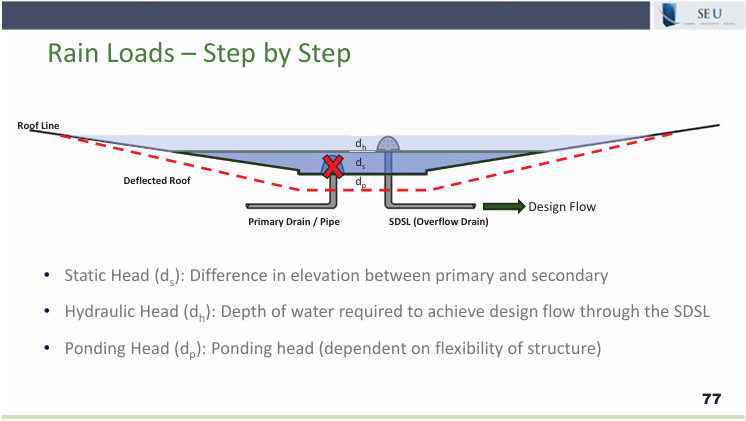
In the past, the Return Period for rain events was 100 years in all cases. ASCE 7-22 has included changes to the Return Period based on Risk Category. Risk Category III now uses a 200 year Return Period and Category IV uses a 500 year Return Period, as shown in Table 8.2-1. The hydraulic head, dh, can then be calculated using Tables C8.2-1 and C8.2-3 depending on the type of secondary drain used.
The Ponding Head, dp, can then be calculated through an interactive approach. Scott recommends using the free and newly updated SJI Ponding Analysis Tool which can be accessed by clicking on the link. Scott also referenced the research performed by Mark Denavit in 2019 which appeared in Engineering Structures and can guide the user through the amplified first-order analysis.
Scott noted other small changes to Section 8.3 Bay with Low Slope which directs the user where to expect ponding, and Section 8.4 which warns against drainage systems for new construction discharging water onto existing roofs unless the existing roof is re-evaluated and/or modified to support the new loads,
The new changes to the rain loads in ASCE 7-22 provide the method to determine the new Design Rain Load and offer guidance on roofs that may be susceptible to ponding. Be sure to check out the most recent version of the SJI Ponding Analysis Tool to assist your future roof designs and reduce calculation time for this new iterative analysis.
29 Jun 2026
TnA Bolts a New Option in AISC 360-22
A new option for a high strength fastener has been included in AISC 360 and engineers may be interested in the benefits of using this new system. With the possibility of saving on material and labor costs, the new TnA bolt could be a solution on your next project.
In the March 2026 SEU session, Matt Mester, PE, SE from MiTek, Inc. presented Changes to Steel: ASIC 360 and 341 Code Updates. Matt reviewed when the building code requires the use of AISC 360/341-16 versus AISC 360/341-22. He noted significant changes in AISC 360 and 341 and described some of the new structural systems and materials/grades that are allowed in the new AISC 360 and 341.
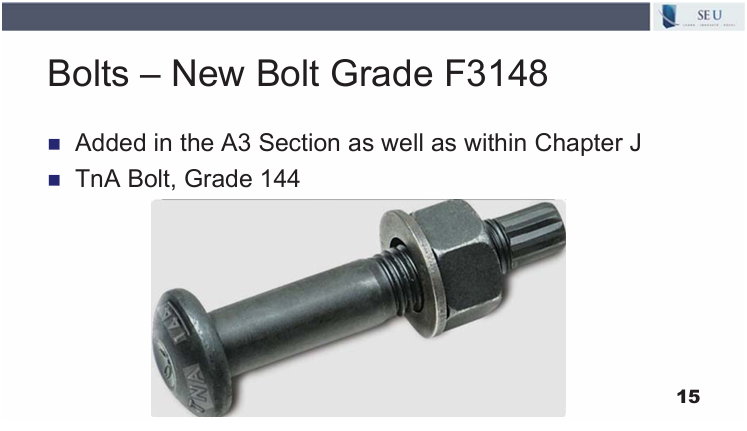
Matt noted the addition of a new bolt in AISC 360 which meets the ASTM F3148 specification. The torque and angle bolt, or TnA bolt, grade 144 has been added in the A3 section as well as within Chapter J. The TnA bolt installation process ensures each bolt is installed to an accurate snug tight condition and then is turned to the required angle to reach a precise final tension. The new bolt offers more reliability than a typical snug tight installation. The TnA bolt grade is 144 which falls between the popular A325 bolt which is grade 120 and A490 bolts which are grade 150. The higher strength could require the use of less bolts compared to the standard A325, which could reduce costs.
As you can see in the slide below, this new bolt has a stub on the end which is similar to a Tension Controlled bolt. However, while the TC bolt stub falls off once the bolt reaches the required pretension force, the stub on the TnA bolt remains in place even after the bolt is torqued to a snug tight condition. This could be a potential downside on jobs where the design tolerances are quite minimal, and the remaining stub could cause a conflict. However, it also allows for removal of the bolt using the same wrench which could be an advantage, especially in structures that may be temporary in nature. The addition of the TnA bolt to the specification gives engineers a new option for a fastener with a mid-grade strength.